|
|
|
|
|
|
|
Aguilar de Campoo, dominated by a XII century castle situated at the Peña Aguilon crag, is a key point in the route of the Romanesque art in Palencia’s province. Aguilar’s historic city centre has been declared as Heritage of Cultural Interest.
Its background tells us of Iberian, Roman and Visigoths. Its history is so rich that we should concentrate in the Romanesque representations which can be found in the village, but we should also enjoy the popular architecture of its old centre.
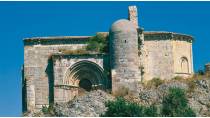
Chapel of Santa Cecilia (Aguilar de Campoo)
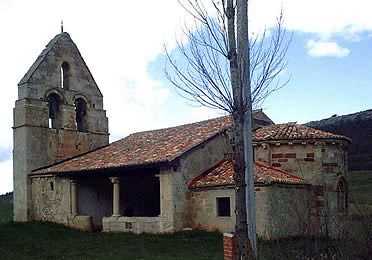
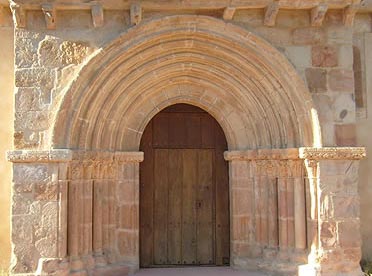
It is a simple rural chapel of small dimensions (19x19 metres) in strong masonry. It is formed by a simple nave, a presbytery and a semicircular apse. The façade, at the southern face, is protected by an open courtyard which, along with the prismatic-cubic tower attached to that same wall, makes it look like a fortress.
Its catalogue of sculptures is quite exceptional. The façade has seven pointed archivolts decorated with plant motifs, mouldings and scotias. The capitals, which they are supported by, form a “continuous frieze” with biblical and fantasy scenes. The bas-reliefs on the cornice modillions also stand out (some of them presenting erotic motifs) as well as the ones on the archivolt and capitals of the apse window and on the inside double pointed triumphal arch (saw tooth architecture, scene of Samson and the lion and fantastic animals).
|
| Information: |
Visiting Hours:
From July 16th to Sept.18th
From 11:00 to 14:00
From 17:00 to 20:00
Holy Week: same timetable
Prices:
General: 1€
|
|
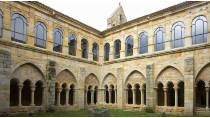
Monastery of Santa María la Real (Aguilar de Campoo)
It is one of the most emblematic Romanesque buildings in Palencia. It dates from the XIII century. The monastery’s church is formed by three naves with three apses, of which two are
preserved. The pillars of the nave have cruciform shape. The cloister, which represents the transition to Gothic style, has a semi-circular arcade with columns decorated with capitals and
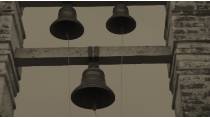
cymatia. In the exterior the most outstanding elements are the big belfry and a façade with three splayed archivolts on pairs of bent columns. The Monastery houses the Romanesque
Study Centre at the present time.
|
| Information: |
Visit Hours:
From July 1st to Aug 31st
From Monday to Sunday
From 10:30 to 14:00
From 16:30 to 19:30
From Sept 1st to June 30th
From Tuesday to Friday
From 16:00 to 19:00
Holidays and Weekends
From 10:30 to 14:00
From 16:30 to 19:30
Closing days: Monday
Prices:
General: 5€
|
|
Church of Santa María (Aguilar de Campoo)
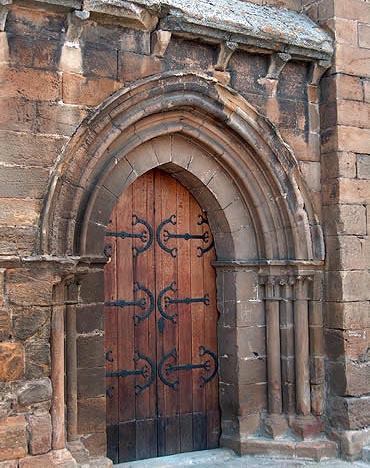
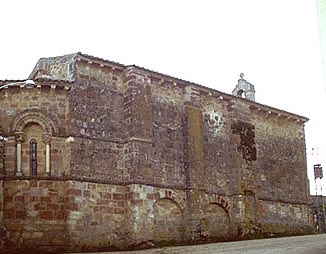
The church surprises mostly because of the dark reddish and greyish colour of the sandstone masonry which was used on its construction. The building has Latin cross plan with three naves of three sections, same width transept and triple semicircular apse, which is the most interesting detail of the whole collection.
It is also peculiar because of its austere decoration, mainly concentrated at the western door. It is a pointed arch with four archivolts decorated with saw tooth and mouldings resting on
stylized columns and capitals sculptured with vegetal motifs.
The interior preserves pointed barrel vaults with arches. The transept´s dome, with square plant, stands on a semi spherical cupola on trunks.
|
| Information: |
Visit Hours:
From July 16th to Sept 18th
From 11:00 to 14:00
From 17:00 to 20:00
Holy Week: same timetable
Prices:
General: 1€
|
|
Collegiate Church of San Miguel (Aguilar de Campoo)
The Collegiate of San Miguel in Aguilar de Campoo occupies a privileged place in the town, closing with its façade the eastern side of the Plaza de España Square, which is the trade and social centre of Aguilar.
There are important Romanesque remains like a façade in the western front, large windows, firrings and the tympanum of another door encrusted in its walls which shows a Christ in Majesty.
The architecture of the rest of the building is mainly Gothic from the XIV century. Nevertheless it shows a very primitive design, sometimes still attached to the Romanesque tradition, as it can be seen in its large western door with pointed archivolts on columns with vegetal capitals.
The Gothic headpiece is impressive. It has got polygonal plant with big buttresses at the corners and large pointed windows.
The big Herrerian tower of the gable in the outside also stands out and it can be seen from almost all streets in Aguilar.
The inside is formed by three naves covered by groin vaults. A baptismal font and a Renaissance altarpiece. Tombs from the XII to the XVI centuries can also be found, among which the most important are those from the Marquises of Aguilar.
The art museum can also be visited. It is mainly composed of religious art, including the parish treasure with precious metal articles, paintings and ivory articles.
|
| Information: |
Summertime:
From June 1st to June 30th and from October 1st to 15th
Friday to Sunday: from 10:30 to 13:30 and from 17:00 to 20:00
July, August and September
From Tuesday to Sunday from 10:30 to 13:30 and from 17:00 to 20:00
Wintertime:
From October 16th to May 31st
Monday to Sunday from 12:00 to 13:00
|
|
Chapel of Santa Eulalia (Barrio de Santa María)
It is named as a chapel because it is an isolated religious building surrounded by nature, but it was the parish church of a village which no longer exists.
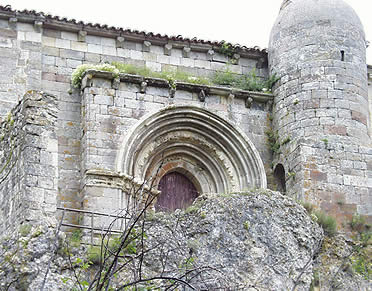
The ground on which it is situated is surprisingly sloping and the southern wall is therefore literally nailed to the land.
The Chapel of Santa Eulalia is a quite small building but the quality of its artistic and construction plans is enormous. It is one of the Romanesque jewels of the Alfoz of Aguilar de Campoo and all the north of Palencia. As we may see, in this church several facets of the Romanesque art can be admired at the place: architecture, sculpture, paintings and even ironwork from that time.
|
| Information: |
There is no specific timetable to visit the church. It is enough to call the following telephone
numbers to get the key of the church.
979 181 248 / 686 660 025
(Conce or Celia)
|
|
Church of Santa Cecilia (Vallespinoso de Aguilar)
It is a well-built monument with highly surprisingly sculptures. To begin with, the capitals of the huge façade are actually a sculpture frieze spread all trough the barbican’s wall. We can
find biblical and fantastic scenes in it: The three Marys, warriors, dragons, etc.
In the inside, the triumphal arch and the apse arcades are also examples of the excellent sculpture repertoire.
|
| Information: |
Details of contact person
at the door.
Prices:
General: 1€
|
|
Monastery of Santa María de Mave (Santa María de Mave)
Its facilities have been transformed into hostelry at the present time.
Its monumental Romanesque church remains in a perfect condition of preservation.
It is formed by three huge naves which end in a monumental headpiece of three semicircular apses.
The whole building is provided with monumental but rather sober architecture as to decoration since the usual columns are replaced in this case by buttresses, and its large windows show bent arches with no decoration.
The most decorated part is undoubtedly the door of the western gable, which is formed by fine pointed archivolts. Two of them with saw tooth and the rest with thin mouldings.
The collection of columns is magnificent. It does not only have proportional and slender timber, but also a fine collection of capitals with incredibly elegant vegetal motifs. This façade
is indebted to the style imposed by the Monastery of San Andrés de Arroyo, also a monument from Palencia.
A simple baptismal font and a big reused capital are kept in the inside.
|
| Information: |
At the present time “El Convento” Lodge: ask for visits here
979 12 36 11
|
|
Church of Santa María (Valdegama)
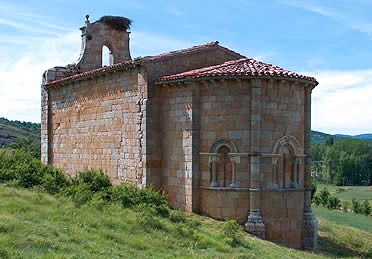
It is a quite small religious building that preserves the drum apse with central large window and the belfry of the gable. The belfry is off-centred in relation to the nave, what could mean a modern reconstruction of the same (XVII century), or even a construction of that same century with old-fashioned shapes based on the Romanesque style.
We may also be surprised by the chromatic alternation of the headpiece’s masonry which range from grey to intense wine colour.
|
| Information: |
|
|
Church of San Andrés (Gama)
Gama preserves the remains of its castle and its Romanesque parish church dedicated to San Andrés.
In the church we can especially stand out the quality of its southern door, the collection of firrings and the inner capitals of the triumphal arch, with the scene of Samson in the pit of the lions and a fight between knights.
|
| Information: |
|
|
|
|

 |
 |
|